
Market Structure
30-Second Definition
The overall framework of how price action moves and behaves over time, characterized by the continuous sequence of swing highs and swing lows that define trends and ranges.
Why It Matters
If you do not understand Market Structure, you are driving blindfolded. It is the absolute most important concept in technical analysis, superseding all indicators, oscillators, and algorithms. Market Structure is the raw, unedited language of price.
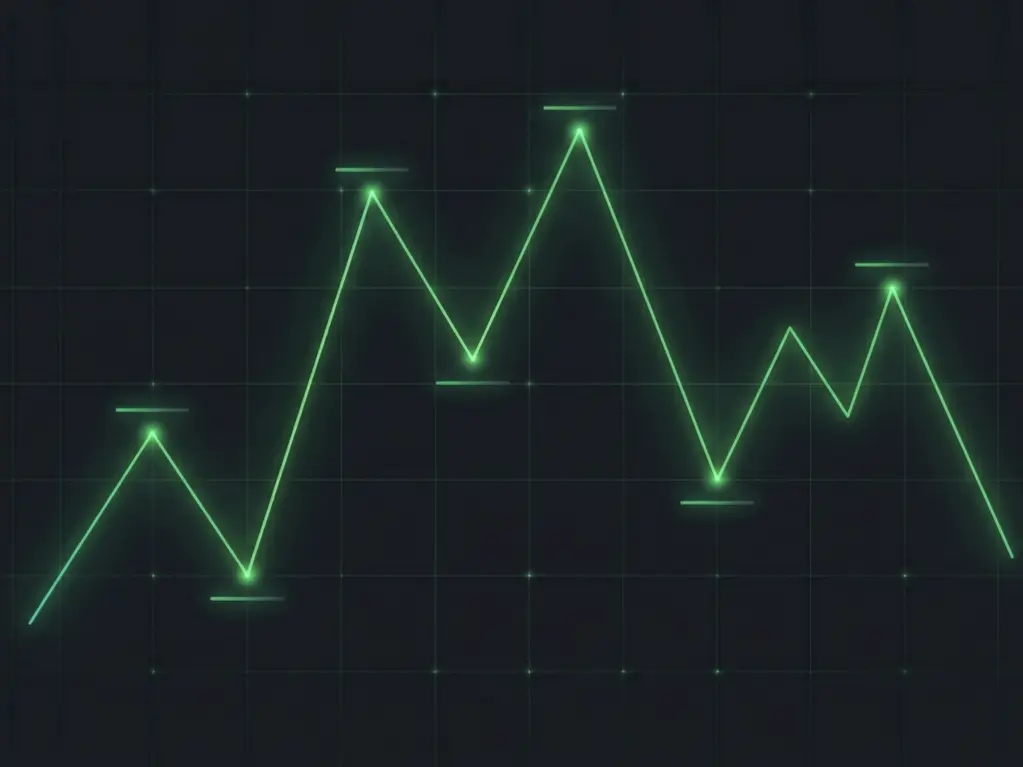
It tells you exactly who is currently in control of the market. If the structure is printing Higher Highs and Higher Lows, buyers (demand) are in control. If it is printing Lower Lows and Lower Highs, sellers (supply) are in control. If it is printing equal highs and lows, the market is in a state of equilibrium (consolidation). Every single high-probability trading strategy in existence relies on aligning entries with the dominant higher-timeframe Market Structure.
Visual Explanation
Real Trading Example
A trader boots up their charts for the day. Before looking at a single 5-minute candlestick, they open the Daily chart.
They map the Market Structure. They identify the most recent major Daily High at 1.1000 and the Daily Low at 1.0800. They notice that the price recently broke 1.1000, creating a new Higher High. The macro Market Structure is definitively Bullish.
Armed with this knowledge, the trader drops down to the 15-minute execution chart. The 15-minute chart is currently crashing downward. A novice would panic and sell. But the professional knows this is just a minor pullback within the Daily Bullish Structure. They wait for the 15-minute chart to hit a Discount zone, execute a Buy order, and ride the structural wave back upward.
Common Mistakes
Common Mistake
Getting Lost in the Noise: Retail traders often map every single tiny bump on a 1-minute chart as a “major structural point.” This leads to analysis paralysis, as the structure appears to change every three minutes. True Market Structure is defined by major, obvious swing points that are clearly visible even when zoomed far out on a higher timeframe.
Professional Tips
Pro Tip
Fractal Nature: Market Structure is fractal, meaning it exists simultaneously on all timeframes. A massive Daily uptrend is actually composed of hundreds of tiny 5-minute uptrends, consolidations, and downtrends. The secret to professional trading is waiting for the 5-minute Market Structure to shift (CHOCH) into alignment with the 4-Hour Market Structure before entering a trade.
FAQ
What happens when Market Structure is broken?
When the defined sequence of structure fails (e.g., an uptrend fails to make a Higher High and instead breaks below the previous Higher Low), the structure is broken. This is known as a Change of Character (CHOCH) and signals a high probability that the macro trend is reversing.
Should I trade against the Market Structure?
Counter-trend trading is possible, but it is the hardest way to make money in the markets. When you trade against the macro structure, you are fighting the institutional momentum. Your win rate will be drastically lower, and your holding times will be much shorter. It is always easier to swim with the current.
How do indicators help with Market Structure?
Indicators (like RSI or MACD) do not dictate Market Structure; price action does. However, indicators can be used as secondary confluence. For example, if the Market Structure prints a Higher High, but the RSI prints a Lower High (Divergence), it warns the trader that the structural momentum is weakening.
Related Concepts
Still have questions? Ask TradeGuardian AI.
Get instant, cited answers from our proven library of frameworks and strategies.