
Daily Loss Limit
30-Second Definition
The maximum amount a trader is allowed to lose in a single trading day on a prop firm account, measured from the day’s starting balance or equity. Breaching it terminates the evaluation or funded account immediately.
Understanding the Daily Loss Limit
The daily loss limit (also called the daily drawdown or maximum daily loss) is a hard risk boundary set by proprietary trading firms. It caps how much your account can fall within a single trading day. Cross it — even by one cent, even for one second — and the account is breached automatically.
It is measured from a fixed reference point set at the daily reset (commonly 00:00 CET / 5:00 PM EST), then applied as a fixed percentage of that starting value.
Key Characteristics
- Typical size: 3% to 5% of the account’s starting-day balance or equity.
- Separate from maximum drawdown: You can be well inside your overall drawdown limit and still fail by breaching the daily limit alone.
- Equity-based (most firms): Includes open floating losses, so a losing position can breach you before you close it.
- Balance-based (rarer): Only closed trades count toward the limit.
- Resets daily: The allowance refreshes at the firm’s reset time, not at your local midnight.
Why It Matters
The daily loss limit is responsible for the single largest share of failed prop firm challenges. It exists to stop one emotional session — revenge trading, oversizing, or holding a floating loss — from wiping out the firm’s capital.
For the full mechanics, worked examples, and a protection framework, read Daily Loss Limit Explained. To see how it fits alongside overall limits, see How to Calculate Prop Firm Drawdown.
Visual Explanation
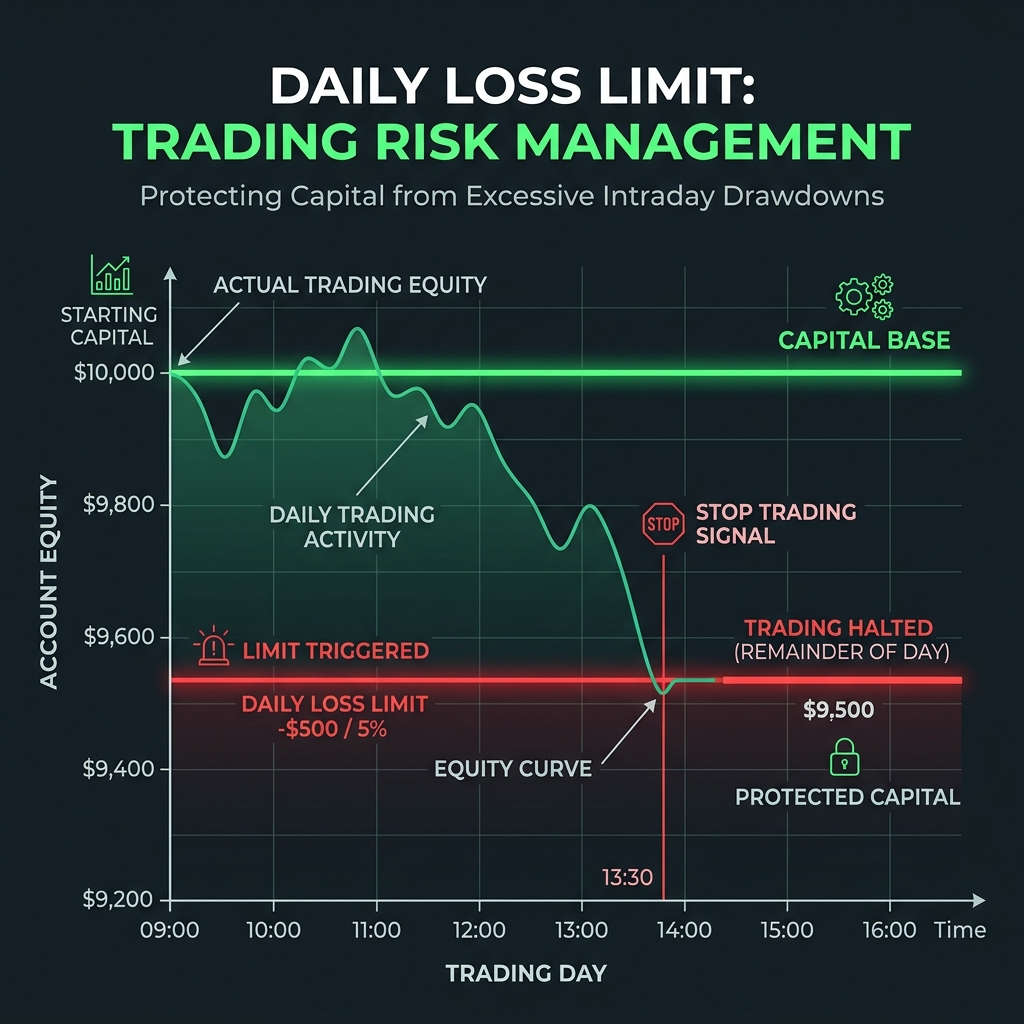
Real Trading Example
In a live trading environment, proper execution of this concept prevents emotional reactions. For example, if the market shifts aggressively during a New York session, relying on mechanical rules rather than intuition protects the account capital.
Common Mistakes
Common Mistake
Ignoring the rules: Many beginner traders fail because they abandon their pre-trade checklist the moment they face consecutive losses.
Professional Tips
Pro Tip
Mechanical Execution: Treat every trade as a simple execution of your mathematical edge. Over a sequence of 100 trades, individual emotional reactions are irrelevant.
FAQ
Is this allowed in prop firms? Yes, understanding and applying this concept is completely aligned with prop firm rules.
How long does it take to master? It requires consistent journaling and backtesting, typically taking several weeks of dedicated practice.
Still have questions? Ask TradeGuardian AI.
Get instant, cited answers from our proven library of frameworks and strategies.