
Emotional Trading
30-Second Definition
The act of making financial market decisions based on physiological feelings (fear, anger, greed, hope) rather than objective data, technical analysis, and mechanical rules.
Why It Matters
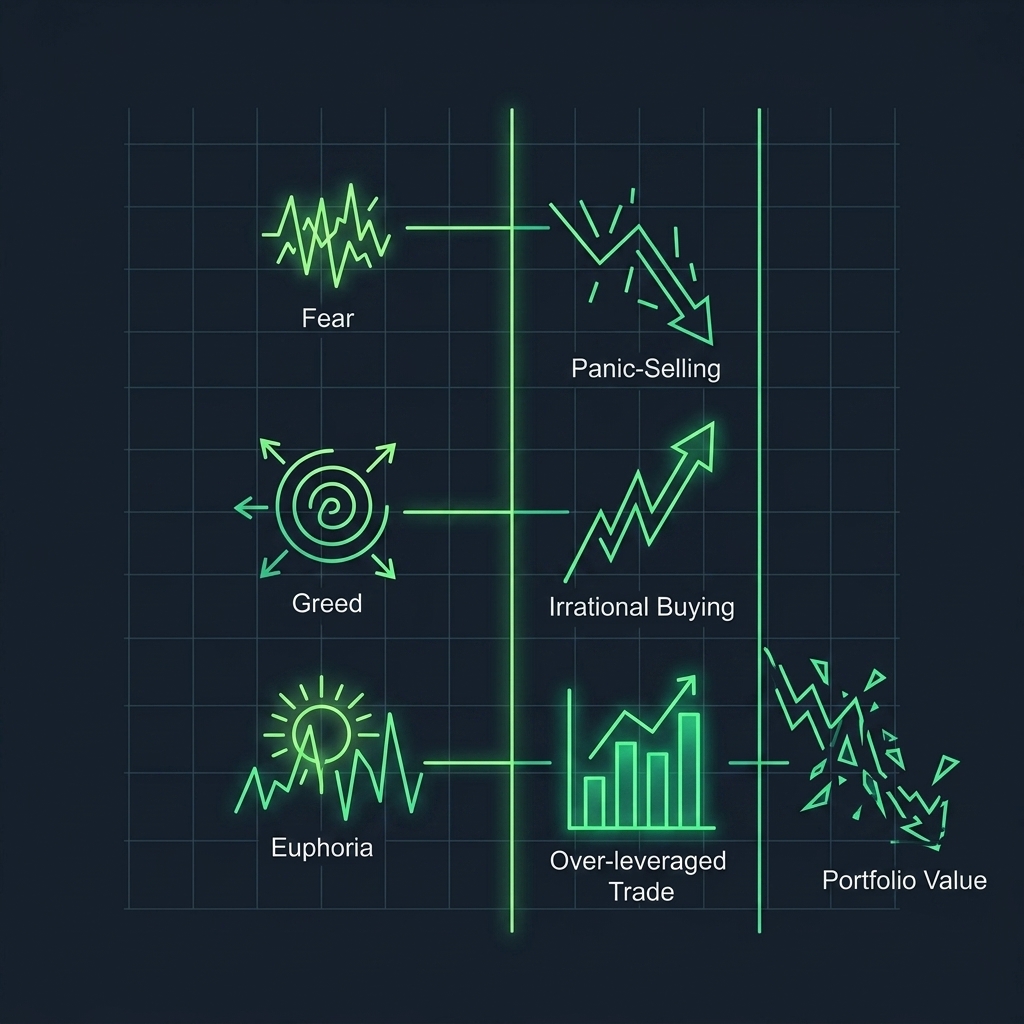
Emotional trading is the root cause of 99% of retail trader failures. The human brain evolved to seek safety (fear) and hoard resources (greed). These evolutionary traits, while excellent for primal survival, are fundamentally destructive in a probabilistic environment like the financial markets.
When a trader operates emotionally, they are no longer trading the market; they are trading their own internal psychological state. They hold onto losing trades because they “hope” they will return to breakeven, and they cut winning trades early because they “fear” losing the small profit. To succeed, a trader must build mechanical systems that completely bypass these destructive human impulses.
Visual Explanation
Real Trading Example
A trader enters a short position on USDCHF. Immediately after entry, the price spikes aggressively upwards, putting the trader in a 1.5% floating loss.
An Emotional Trader begins sweating and staring intensely at the 1-minute chart. They pray for the market to drop. Unable to handle the pain of the red numbers, they manually close the trade for a 1.5% loss, completely abandoning their original 2% stop loss plan.
A Mechanical Trader in the exact same position calmly walks away from the computer. They know their stop loss is placed. They have already accepted the risk. Ten minutes later, the market rejects the high and drops violently, smashing the Take Profit target. The emotional trader secured a loss; the mechanical trader secured a win, simply by removing emotion.
Common Mistakes
Common Mistake
Revenge Trading After a Loss: The most dangerous emotional state occurs immediately after taking a loss. The ego is bruised, and the trader feels an intense urge to “get back” at the market by instantly entering a new, usually overleveraged, position.
Professional Tips
Pro Tip
Monitor Your Physiology: Emotional trading begins in the body before the mind. If you notice your heart rate increasing, your breathing becoming shallow, or tension in your shoulders while managing a trade, you are trading emotionally. Close the terminal immediately.
FAQ
How can I trade without emotion?
You cannot eliminate human emotion completely. The goal is not to become a robot, but to build mechanical execution systems (like hard Stop Losses and Take Profits) that prevent your emotions from interacting with your capital.
Is demo trading good for fixing emotional issues?
Demo trading is excellent for testing mechanics, but it does absolutely nothing to train emotional control. You cannot replicate the psychological pressure of risking real money until you are actually risking real money. Transition to a very small live account to train your emotions.
Why do I only get emotional when I am losing?
Humans feel the pain of a financial loss approximately twice as intensely as the pleasure of an equivalent gain (Loss Aversion). This intense pain triggers the “fight or flight” response, leading to erratic, emotional decisions to try and stop the pain.
Related Concepts
Still have questions? Ask TradeGuardian AI.
Get instant, cited answers from our proven library of frameworks and strategies.