
Funded Account
30-Second Definition
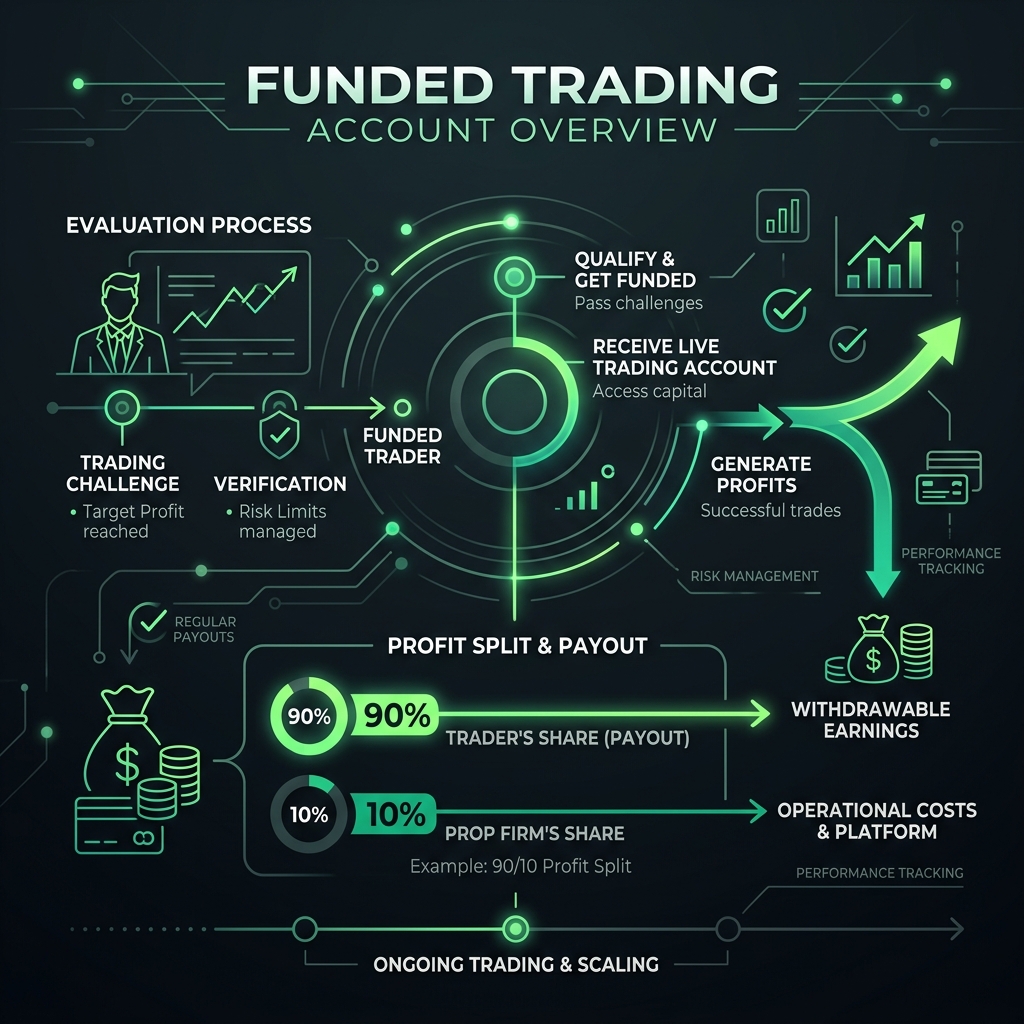
A Funded Account is a simulated live trading account provided by a proprietary firm to a trader who has successfully passed their evaluation process, allowing the trader to earn a profit split on generated returns.
Understanding the Funded Account
A Funded Account (often called a Live or Master account) is the ultimate goal for any retail trader taking a prop firm challenge. Once you pass the Evaluation Phase, the firm issues you credentials for a new account.
While it is commonly called a “Live” account, the vast majority of retail prop firms provide a simulated environment connected to a live data feed (often via B-Book brokerage models). The firm’s proprietary software tracks your performance. If your trades generate a profit, the firm pays you a percentage of that profit (usually 80-90%) out of their corporate funds, often while copy-trading their most successful traders onto actual live market servers.
Key Characteristics
- No Profit Targets: Unlike the evaluation phases, a funded account does not have a required profit target. You can make 1% or 20% in a month; you get paid on whatever profit you generate.
- Strict Drawdowns: The daily loss limit and maximum drawdown rules remain in effect. Breaching these will result in the immediate loss of the funded account.
- Profit Split: Traders typically keep 80% to 90% of the profits generated.
- First Payout: The first payout is usually available 14 to 30 days after the first trade is placed on the funded account.
Why It Matters
Obtaining a funded account shifts the mathematical reality of trading. A trader with $1,000 of personal capital is often forced to take high risks to make meaningful money. A trader managing a $100,000 funded account can risk tiny fractions of a percent, execute calmly, and still generate substantial monthly income.
However, keeping a funded account requires a complete psychological shift. During the evaluation, traders play offense to hit targets. In the funded stage, traders must play defense to protect the account from drawdown breaches.
Visual Explanation
Real Trading Example
A trader secures a $100,000 Funded Account. In their first month, they execute their strategy flawlessly and generate a 6% return ($6,000 profit).
At the end of their billing cycle, they request a payout. The prop firm processes the request, takes their 20% split ($1,200), and wires the remaining 80% ($4,800) directly to the trader’s bank account or crypto wallet. The account balance is then reset to $100,000 for the next trading cycle.
Common Mistakes
Common Mistake
The “I Made It” Syndrome: Traders often relax their discipline once funded, treating the account like play money because they didn’t deposit the $100,000 themselves. This lack of respect for risk usually results in blowing the account within the first week.
Professional Tips
Pro Tip
Secure the First Payout: The primary goal of a newly funded trader should be to secure the first payout, no matter how small. This usually triggers a refund of your initial evaluation fee, meaning your financial risk drops to absolute zero. After the refund is secured, you are truly playing with house money.
FAQ
Do I have to pay for losses on a funded account? No. You are not liable for trading losses on a funded account. If you breach the drawdown limits and blow the account, you simply lose access to it. Your personal financial risk is limited to the evaluation fee you paid at the start.
Can I scale my funded account? Yes. Most prop firms offer scaling plans. If you demonstrate consistent profitability over several months (e.g., a 10% gain over 4 months with multiple payouts), the firm will automatically increase your account balance, sometimes up to $2,000,000.
Are the funds real? For retail prop firms, the account you trade on is usually simulated. The firm pays your profit split out of their own capital pool, which is funded by evaluation fees and the institutional copy-trading of their best traders.
Still have questions? Ask TradeGuardian AI.
Get instant, cited answers from our proven library of frameworks and strategies.