
Leverage
30-Second Definition
Borrowed capital provided by a broker that allows a trader to control a large position size with a relatively small amount of personal margin.
Why It Matters
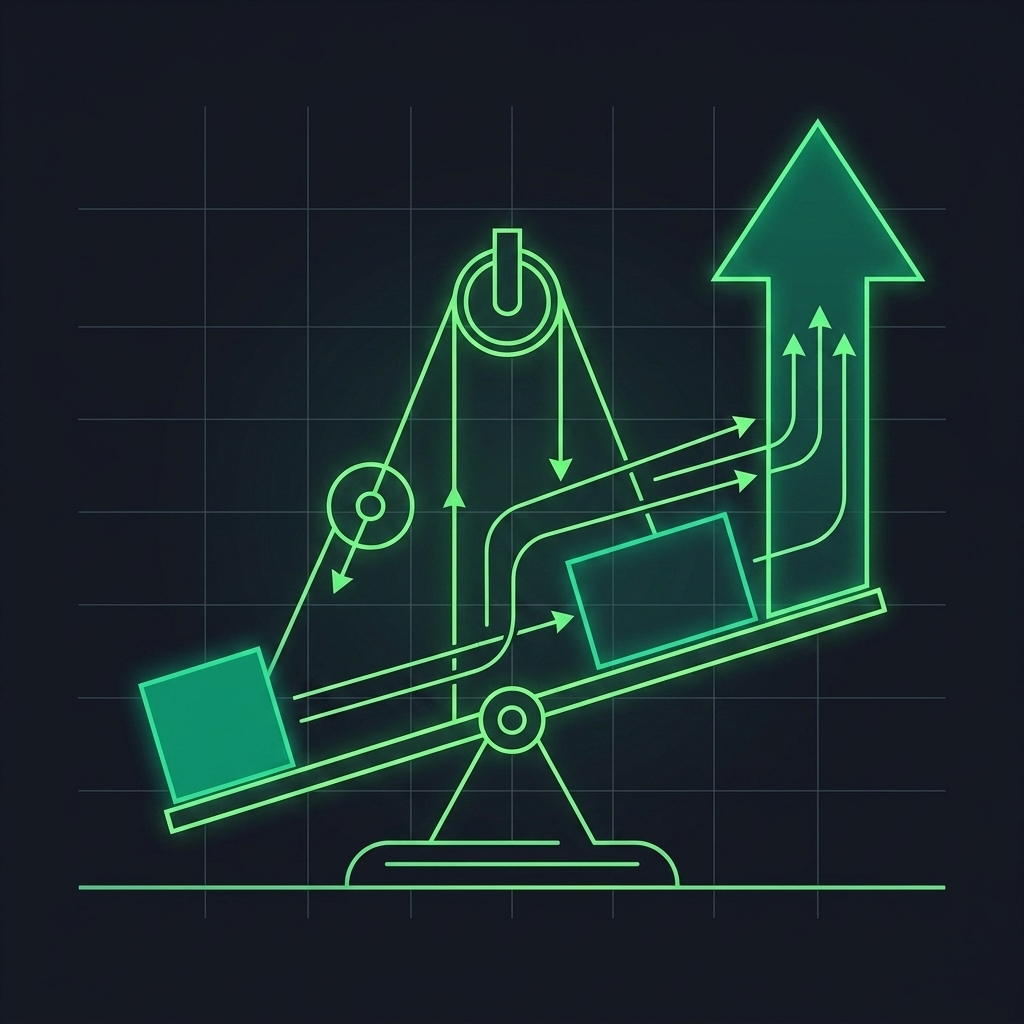
Currencies in the forex market move by fractions of a cent (pips) every day. If you traded 1:1 leverage (using only your own money), a 1% move in a currency would yield almost negligible returns. Leverage amplifies this buying power, making retail forex trading viable.
However, leverage is a double-edged sword. While it amplifies potential profits by allowing you to control massive lot sizes, it equally amplifies potential losses. If a trader uses excessive leverage to open a position far larger than their account can safely sustain, a tiny market fluctuation can instantly wipe out their entire equity.
Visual Explanation
Real Trading Example
A broker offers 1:100 leverage. This means for every $1 in the trader’s account, they can control $100 of currency in the market.
A trader wants to buy 1 Standard Lot of USDJPY, which is $100,000 worth of currency. Without leverage, the trader would need exactly $100,000 in cash to open the trade. With 1:100 leverage, the trader only needs to put up $1,000 of their own money (margin) to secure and control the $100,000 position.
If the trade yields a $500 profit, the trader made a 50% return on their $1,000 margin investment in a single trade. If the trade loses $1,000, their entire margin is consumed, and the account is blown.
Common Mistakes
Common Mistake
Maxing Out Buying Power: Amateurs view high leverage (e.g., 1:500) as an instruction to open the largest lot size possible. High leverage does not mean you should use it all. It simply means you require less margin to open your standard, risk-managed positions.
Professional Tips
Pro Tip
Leverage is Irrelevant with Proper Sizing: If you strictly follow a 1% Risk Per Trade rule using proper Position Sizing mathematics, your broker’s leverage ratio does not matter. Whether you have 1:30 or 1:1000 leverage, your risk remains locked at 1% of your equity. Leverage only dictates how much free margin you have left over.
FAQ
Why do regulators limit leverage?
Financial regulators (like the SEC in the US or ESMA in Europe) heavily restrict retail forex leverage (often capping it at 1:30 or 1:50) to protect inexperienced retail traders from rapidly losing their life savings due to over-leveraging on volatile assets.
How much leverage do prop firms offer?
Most proprietary trading firms offer conservative leverage ratios, typically 1:30 to 1:100 for forex pairs, and often much lower (1:10 or 1:20) for highly volatile assets like Indices or Crypto, to limit the firm’s overall risk exposure.
Does high leverage increase the pip value?
No. Pip value is determined exclusively by the Lot Size you execute. Leverage only determines how much of your account balance is frozen as a deposit (Margin) to allow you to execute that specific Lot Size.
Still have questions? Ask TradeGuardian AI.
Get instant, cited answers from our proven library of frameworks and strategies.