
Maximum Risk
30-Second Definition
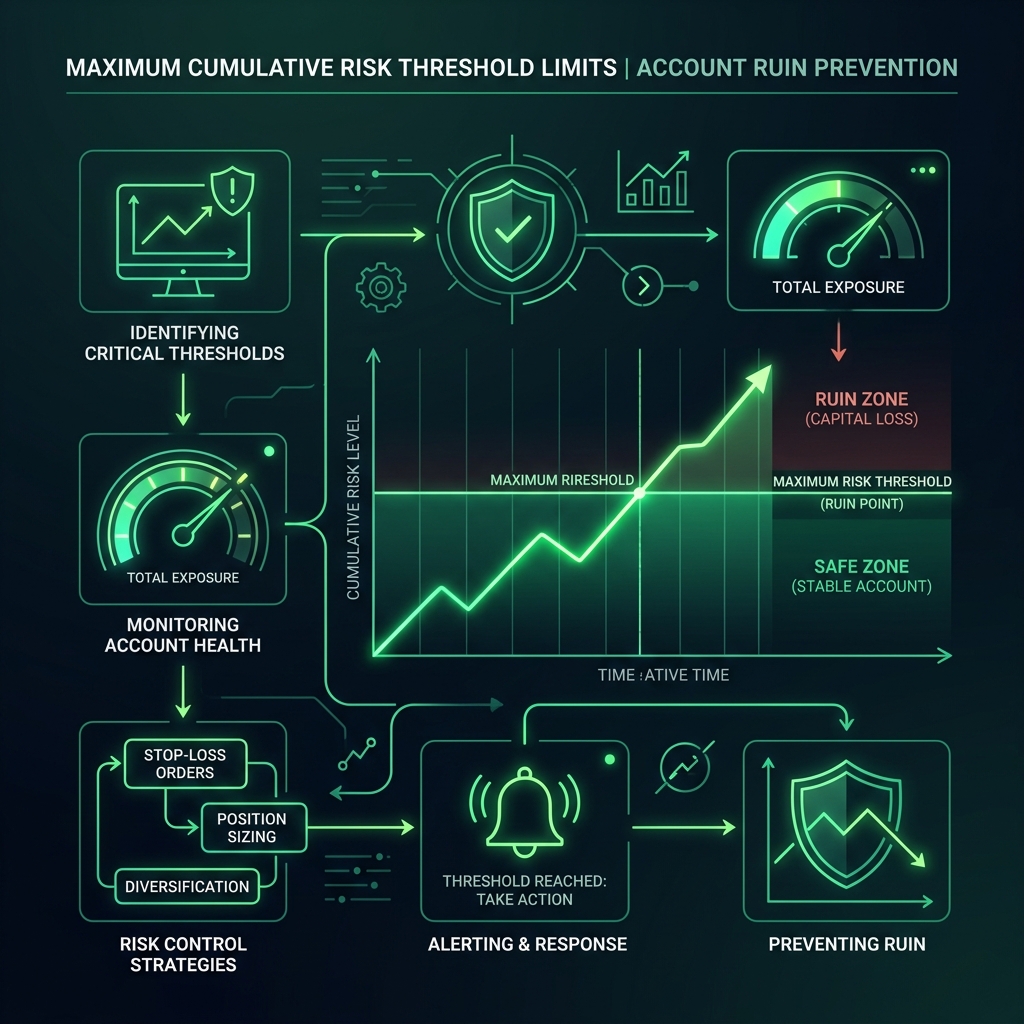
The absolute, non-negotiable ceiling on total accumulated risk across all open positions, preventing total account ruin during extreme market volatility or correlated failures.
Why It Matters
While Risk Per Trade manages the damage of a single losing position, Maximum Risk governs the total exposure of the entire portfolio. A trader might strictly risk 1% per trade, but if they open 10 correlated trades simultaneously and the market moves against them, they are actually exposing the account to a devastating 10% loss in a single swing.
Defining a Maximum Risk limit (e.g., a hard cap of 3% total open risk at any given time) acts as the ultimate circuit breaker. It forces the trader to prioritize the highest probability setups and reject excessive exposure, ensuring that no single market event can irreparably destroy their capital base or breach a prop firm’s daily drawdown limit.
Visual Explanation
Real Trading Example
A trader’s rules state:
- Risk Per Trade: 1%
- Maximum Open Risk: 3%
The trader is currently long on EURUSD (1% risk), long on GBPUSD (1% risk), and long on AUDUSD (1% risk). Their total open Maximum Risk is currently 3%.
A highly favorable setup appears on NZDUSD. Despite it fitting their strategy perfectly, the trader declines the entry. To take the trade would push their total open risk to 4%, violating their Maximum Risk threshold.
Later that day, a surprise US Dollar rally triggers stop losses across all major pairs. The trader loses 3% of their account. Because they adhered to their Maximum Risk rule and rejected the fourth trade, they survive the market event and avoid breaching their prop firm’s 5% daily loss limit.
Common Mistakes
Common Mistake
Ignoring Correlation: Opening multiple trades on EURUSD, GBPUSD, and AUDUSD is often effectively the same as opening one massive trade shorting the USD. Traders who fail to calculate Maximum Risk often unknowingly compound their exposure on highly correlated assets.
Professional Tips
Pro Tip
The Free Trade Strategy: If an open position moves significantly into profit, move its stop loss to the breakeven entry point. Because that trade can no longer lose money, its risk becomes 0%. You have now freed up capacity in your Maximum Risk allowance to take a new, unrelated setup.
FAQ
What happens if I exceed Maximum Risk?
Exceeding Maximum Risk exposes the account to mathematical ruin. In proprietary trading, it drastically increases the probability of hitting a Daily Loss Limit or Maximum Drawdown hard breach, resulting in the immediate termination of the funded account.
Should my Maximum Risk align with my Daily Loss Limit?
Your Maximum Risk should always be lower than your Daily Loss Limit. If a prop firm imposes a 5% Daily Loss Limit, capping your total open Maximum Risk at 2.5% to 3% provides a critical buffer against slippage and widened spreads during volatile events.
How do I calculate open risk?
Calculate the maximum potential dollar loss if every single stop loss on every open trade is hit simultaneously. Divide that total dollar amount by your current account balance to find your total open risk percentage.
Related Concepts
Still have questions? Ask TradeGuardian AI.
Get instant, cited answers from our proven library of frameworks and strategies.