
Reward Split
30-Second Definition
The percentage of generated profits that a funded trader is entitled to withdraw.
What is a Reward Split?
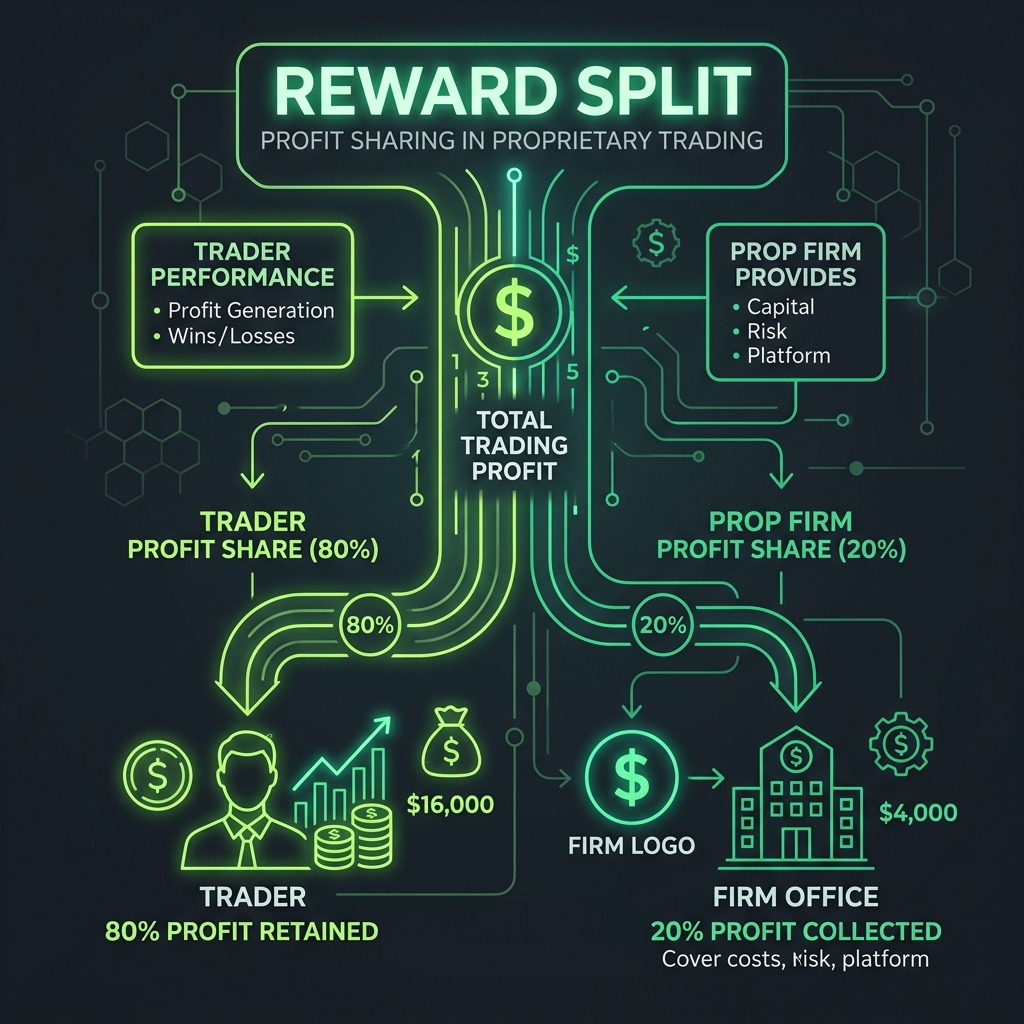
A Reward Split (or profit split) is the agreed-upon percentage of trading profits that a trader keeps when requesting a payout from a proprietary trading firm.
For example, on a standard 80/20 reward split, a trader who generates $10,000 in profit will receive $8,000, while the firm retains $2,000. Many firms offer scaling plans that can increase the trader’s reward split up to 90% or 100% upon demonstrating long-term consistency.
Conversely, some firms use reward split reductions as a penalty for poor risk management. Under the FundingPips Striking System, accumulating warnings due to excessive Floating Loss can temporarily reduce a trader’s reward split to 50% or even 20%.
Related Terms
Why It Matters
Understanding this concept is essential for maintaining strict risk management and surviving proprietary trading evaluations over the long term.
Visual Explanation
Real Trading Example
In a live trading environment, proper execution of this concept prevents emotional reactions. For example, if the market shifts aggressively during a New York session, relying on mechanical rules rather than intuition protects the account capital.
Common Mistakes
Common Mistake
Ignoring the rules: Many beginner traders fail because they abandon their pre-trade checklist the moment they face consecutive losses.
Professional Tips
Pro Tip
Mechanical Execution: Treat every trade as a simple execution of your mathematical edge. Over a sequence of 100 trades, individual emotional reactions are irrelevant.
FAQ
Is this allowed in prop firms? Yes, understanding and applying this concept is completely aligned with prop firm rules.
How long does it take to master? It requires consistent journaling and backtesting, typically taking several weeks of dedicated practice.
Still have questions? Ask TradeGuardian AI.
Get instant, cited answers from our proven library of frameworks and strategies.