
Trailing Drawdown
30-Second Definition
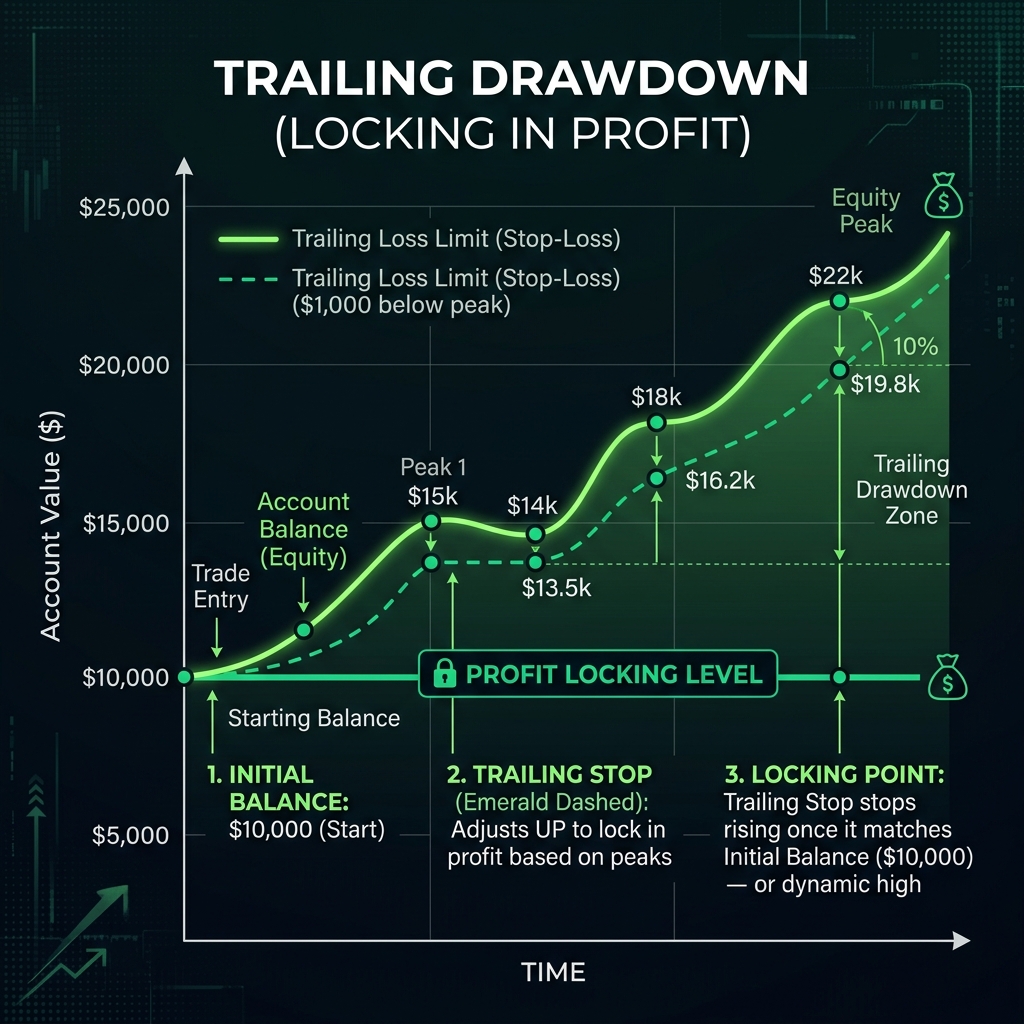
A maximum loss limit that moves up as your account equity reaches new high-water marks, preventing you from building a safety buffer.
What is Trailing Drawdown?
Trailing Drawdown is a strict risk management rule used by many prop firms (especially in the futures space) where the maximum allowable loss limit trails the highest peak in account equity or balance.
If a trader has a $100,000 account with a 10% trailing drawdown ($10,000), the initial breach floor is $90,000. However, if the trader generates $5,000 in profit, establishing a new high-water mark at $105,000, the trailing drawdown floor moves up by $5,000 to $95,000.
Because the floor constantly rises with your profits, you can never build a safety buffer. A trader could make 20% in profit over a month, hit a normal 11% losing streak, and lose the account despite being net positive overall.
Types of Trailing Drawdown
- Intraday Trailing Drawdown: The most difficult type. The floor trails the highest floating equity peak reached during the trading day, even if the trade later closes at a smaller profit.
- End of Day (EOD) Trailing Drawdown: The floor only updates based on the closed balance at the daily reset time.
Related Terms
Why It Matters
Understanding this concept is essential for maintaining strict risk management and surviving proprietary trading evaluations over the long term.
Visual Explanation
Real Trading Example
In a live trading environment, proper execution of this concept prevents emotional reactions. For example, if the market shifts aggressively during a New York session, relying on mechanical rules rather than intuition protects the account capital.
Common Mistakes
Common Mistake
Ignoring the rules: Many beginner traders fail because they abandon their pre-trade checklist the moment they face consecutive losses.
Professional Tips
Pro Tip
Mechanical Execution: Treat every trade as a simple execution of your mathematical edge. Over a sequence of 100 trades, individual emotional reactions are irrelevant.
FAQ
Is this allowed in prop firms? Yes, understanding and applying this concept is completely aligned with prop firm rules.
How long does it take to master? It requires consistent journaling and backtesting, typically taking several weeks of dedicated practice.
Still have questions? Ask TradeGuardian AI.
Get instant, cited answers from our proven library of frameworks and strategies.