
Risk to Reward Ratio
30-Second Definition
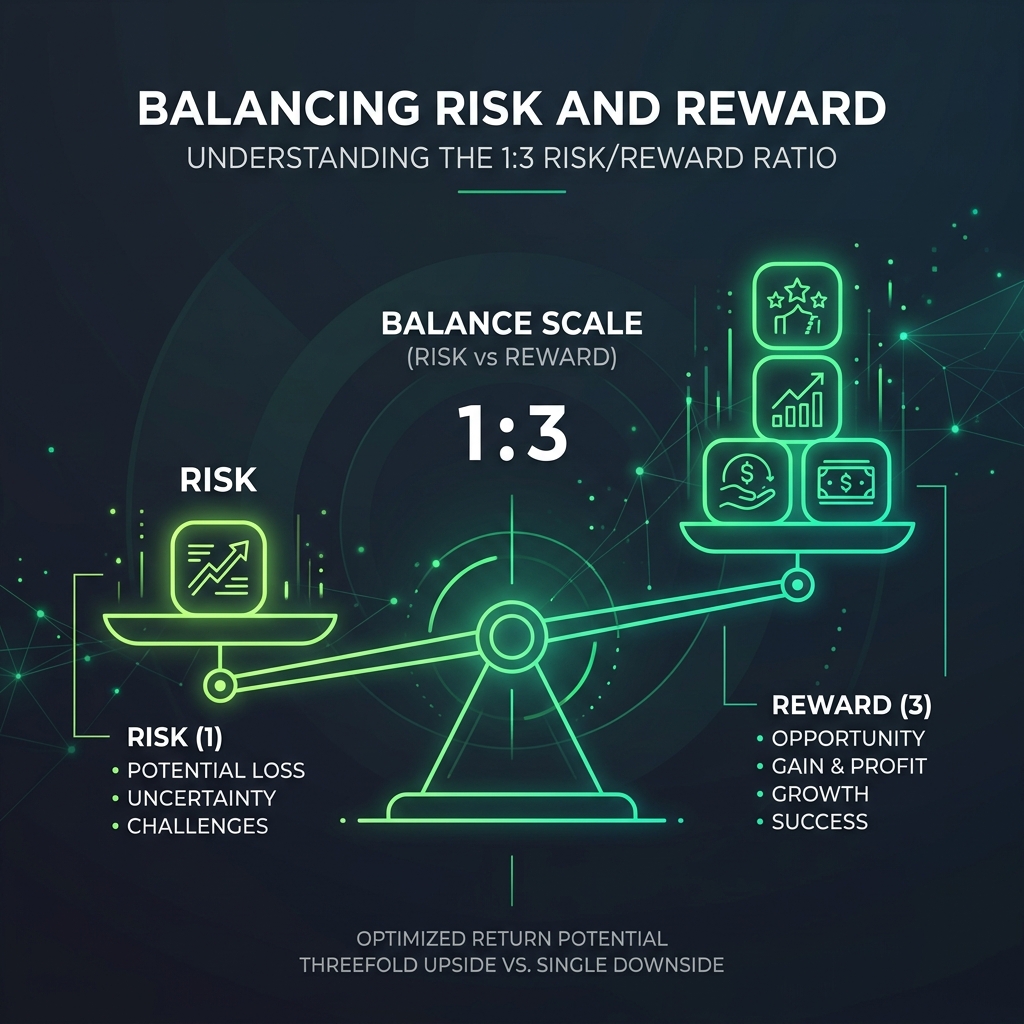
A ratio comparing the potential profit of a trade (reward) to the potential loss (risk). A 1:3 ratio means the trader is risking $1 to potentially make $3.
Why It Matters
The Risk to Reward Ratio (R:R) is the mathematical core of trading profitability. A strategy does not need a high win rate to be profitable if the risk to reward ratio is appropriately skewed in the trader’s favor.
If a trader consistently executes setups with a 1:3 risk to reward ratio, they only need to win 25% of their trades to break even. This dynamic shifts the focus away from the impossible task of “always being right” and towards the mechanical execution of asymmetric bets. Understanding and strictly adhering to minimum R:R thresholds prevents traders from taking setups that do not mathematically justify the capital exposure.
Visual Explanation
Real Trading Example
A trader analyzes the GBPUSD chart and identifies a supply zone. They plan a short position:
- Entry Price: 1.2550
- Stop Loss: 1.2570 (20 pips of risk)
- Take Profit: 1.2490 (60 pips of potential profit)
The trader divides the potential reward by the potential risk (60 / 20) to determine the Risk to Reward ratio. In this example, the ratio is 1:3.
If the trader sizes their position to risk exactly $100 if the stop loss is hit, they stand to make $300 if the take profit is reached. The trader executes the trade, knowing that the mathematical expectancy is highly favorable over a large sample size of similar setups.
Common Mistakes
Common Mistake
Choking the Trade: Many inexperienced traders secure a 1:3 or 1:4 setup, but manually close the trade prematurely when it reaches 1:1 profit due to fear of the market reversing. This destroys the mathematical expectancy of their system.
Professional Tips
Pro Tip
Filter Out Sub-Optimal Setups: Establish a hard rule for your minimum acceptable Risk to Reward ratio (e.g., strictly no trades under 1:2 R:R). If the market structure does not offer enough room to the next logical support/resistance level to satisfy this ratio, cancel the order and wait for a better opportunity.
FAQ
What is a good Risk to Reward Ratio?
Most professional systems target a minimum of 1:2 or 1:3. However, a “good” ratio depends entirely on the system’s win rate. A 1:1 ratio is highly profitable if the system wins 70% of the time, while a 1:5 ratio can be profitable even with a 25% win rate.
How does the ratio affect prop firm evaluations?
Prop firms evaluate consistency. High R:R trades allow traders to absorb the inevitable string of losses without breaching Maximum Drawdown limits, as a single large winner can quickly recover multiple small, controlled losses.
Should I risk more on high R:R setups?
No. The risk amount (e.g., 1% of capital) should generally remain constant regardless of the R:R. The reward side of the equation handles the scaling of profits. Increasing risk arbitrarily breaks the fundamental rules of capital preservation.
Related Concepts
Still have questions? Ask TradeGuardian AI.
Get instant, cited answers from our proven library of frameworks and strategies.