
Stop Loss
30-Second Definition
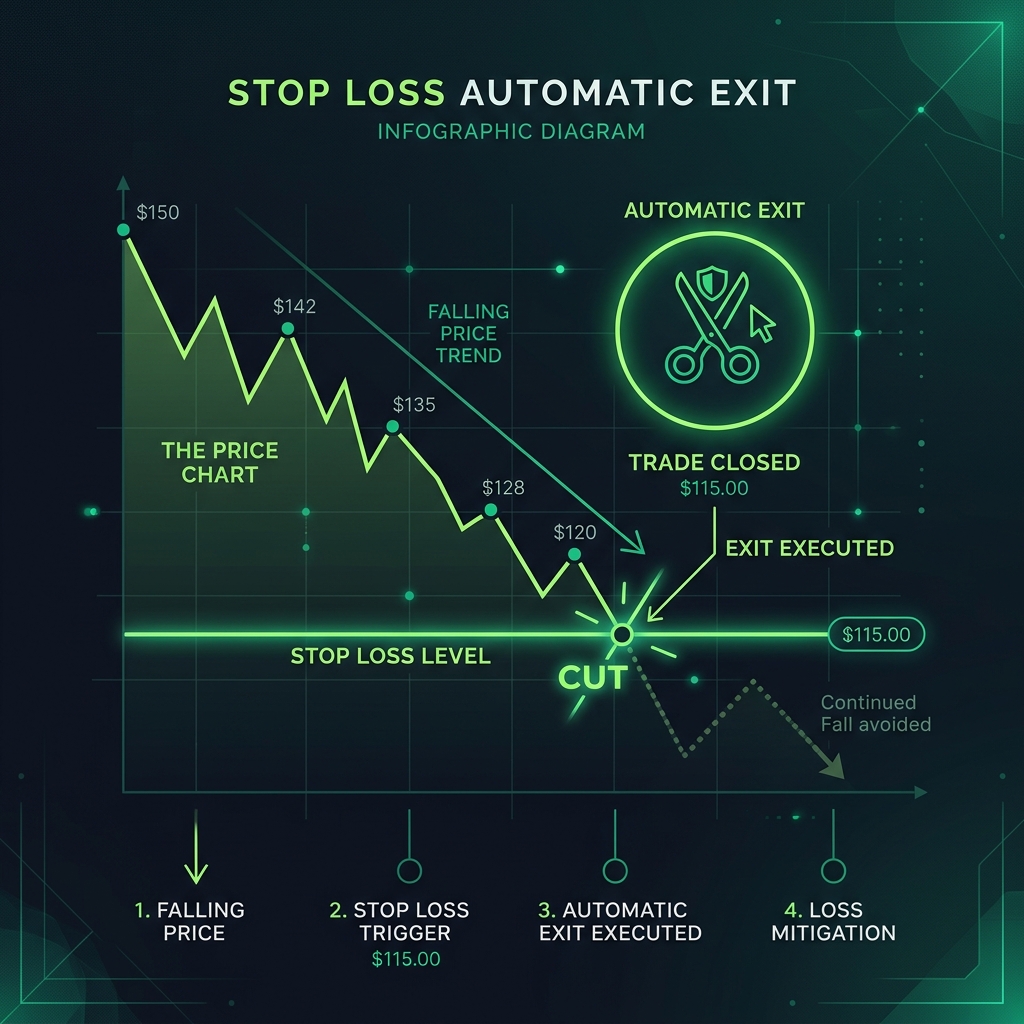
A pre-programmed mechanical order placed with a broker to automatically close a losing position once it reaches a specific, non-negotiable price level, cutting losses instantly.
Why It Matters
The Stop Loss is the ultimate physical boundary between controlled risk and catastrophic failure. Market environments are unpredictable, and even the most meticulously analyzed setups will inevitably fail. A mechanical Stop Loss ensures that when a trade idea is invalidated, the resulting financial damage is mathematically capped and precisely contained.
Without a hard Stop Loss order resting in the market, a trader is vulnerable to sudden volatility spikes, flash crashes, or emotional paralysis. A trader who “mental stops” (promises themselves they will manually close a losing trade if it reaches a certain point) often freezes as the market moves rapidly against them, leading to devastating drawdowns that break proprietary firm rules.
Visual Explanation
Real Trading Example
A technical trader identifies a strong Support level at 1.0500 on EURUSD and enters a long position at 1.0515.
Based on market structure, the trader knows that if the price closes below 1.0490, the entire trade idea is structurally invalidated. They immediately place a hard Stop Loss order precisely at 1.0490.
A surprise economic data release causes the market to violently drop 100 pips in 15 minutes, crashing through the Support level. Because the hard Stop Loss was active on the broker’s server, the position is automatically closed the moment the price touches 1.0490. The trader takes a controlled 25-pip loss. Without the Stop Loss, the trader would have suffered a catastrophic 115-pip loss.
Common Mistakes
Common Mistake
Moving the Stop Loss (Widening): As price approaches the Stop Loss level, amateur traders will often drag the order further away, convincing themselves the market will “turn around soon.” This destroys position sizing mathematics and turns a standard, calculated loss into an account-ruining event.
Professional Tips
Pro Tip
Place the Stop Before Sizing: Never choose a position size first and then randomly assign a 20-pip Stop Loss to match your risk. Always find the technical invalidation point on the chart first. That determines your Stop Loss distance. Only then do you calculate the lot size required to fit your Risk Per Trade into that distance.
FAQ
What is a trailing stop loss?
A trailing stop is a dynamic Stop Loss order that automatically moves with the price as it travels in a profitable direction, locking in gains. If the price reverses, the trailing stop remains stationary, securing a portion of the profit when hit.
Will a Stop Loss guarantee I only lose the exact amount?
Not always. During extreme, unprecedented market volatility (like a central bank intervention), a Stop Loss may experience slippage. The broker executes the order at the next best available price, which may be worse than the specific price you requested.
Do proprietary trading firms require Stop Losses?
Most top-tier prop firms highly recommend them, and some (though increasingly rare) explicitly mandate that every executed trade must have a hard Stop Loss attached to prevent catastrophic “fat finger” or margin call liquidations.
Related Concepts
Still have questions? Ask TradeGuardian AI.
Get instant, cited answers from our proven library of frameworks and strategies.