
Take Profit
30-Second Definition
A pre-programmed mechanical order placed with a broker to automatically close a winning position and secure gains once the market reaches a specific, predetermined price level.
Why It Matters
A Take Profit (TP) order removes emotion and hesitation from the exit strategy. Many inexperienced traders excel at analyzing entries but fail to secure capital because they become paralyzed by greed when a trade moves in their favor, hoping for “just a little more.”
Placing a mechanical Take Profit ensures that when a structural target or liquidity zone is reached, the profit is immediately banked into the account balance. It enforces the mathematical realities of the Risk to Reward Ratio, guaranteeing that the trader actually receives the planned asymmetric reward (e.g., a 1:3 return) before the market has a chance to reverse.
Visual Explanation
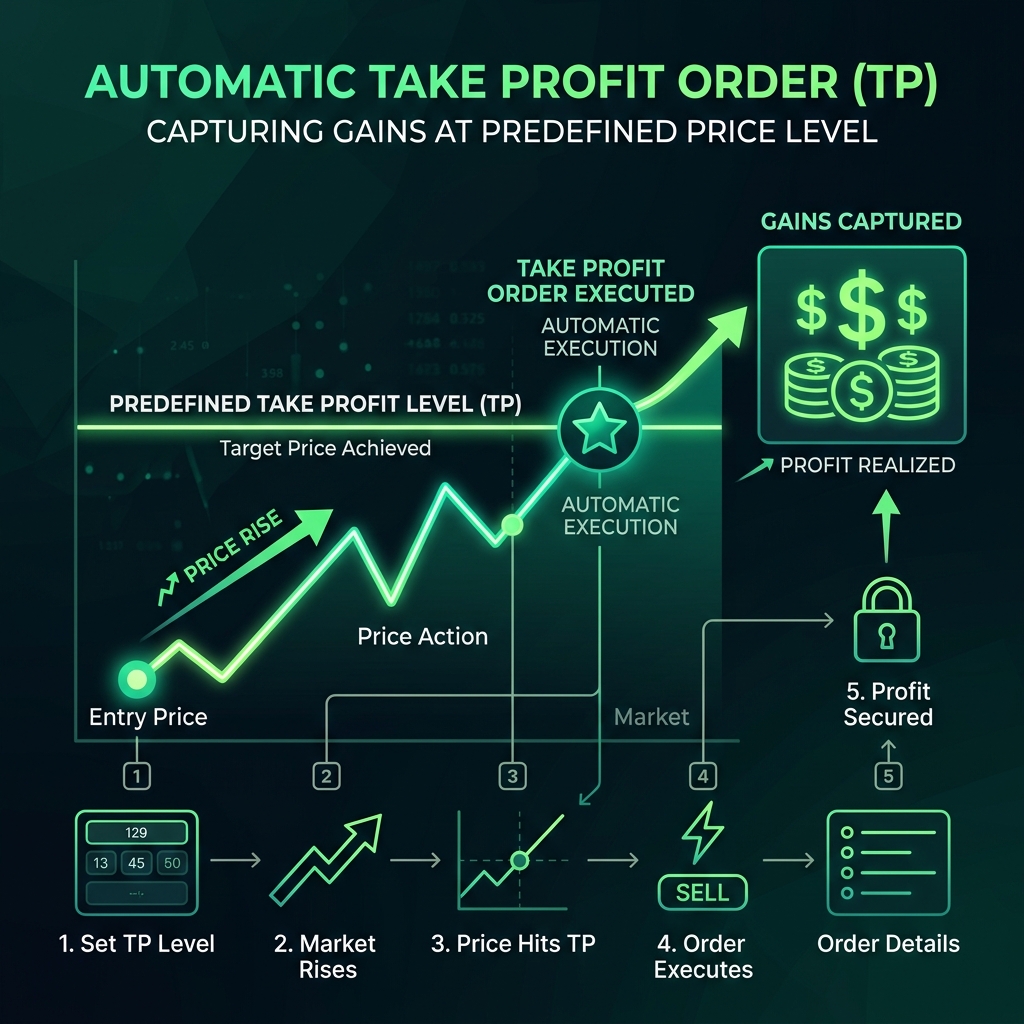
Real Trading Example
A structural trader enters a short position on USDJPY at 150.00. Based on previous market highs and lows, they identify a major Support zone resting at 149.00, where buyers are highly likely to re-enter the market and push the price back up.
The trader places an automatic Take Profit order at 149.05 (slightly above the absolute bottom to ensure execution).
Overnight, while the trader is asleep, the Asian session experiences a quick sell-off. The price spikes down, tags 149.02, and immediately reverses back up to 149.50. When the trader wakes up, they find their position successfully closed in profit. The Take Profit order executed flawlessly at the exact moment the objective was achieved, capturing the gain before the reversal.
Common Mistakes
Common Mistake
Greedy Order Adjustment: An amateur trader watches a trade approach their Take Profit. Feeling confident the momentum will continue forever, they delete the Take Profit order to “let it run.” The market immediately rejects off the target zone and reverses, turning a massive secured win into a breakeven or a loss.
Professional Tips
Pro Tip
Partial Profit Taking (Scaling Out): You do not have to close the entire position at a single Take Profit level. Professional traders often use multiple targets (e.g., TP1, TP2). They program the system to close 50% of the position at the first major structural target, secure the rest to breakeven, and let the remaining 50% target a much deeper macro level.
FAQ
Does hitting a Take Profit affect prop firm drawdowns?
Yes, in a positive way. Because most prop firms track trailing or high-water mark drawdowns, securing profits into the closed balance solidifies the account equity, providing a wider buffer against the Daily Loss Limit for future trading days.
Where should I place my Take Profit?
Take Profits should not be arbitrary numbers (like “always 50 pips”). They should be based on logical market structure—such as previous swing highs, swing lows, fair value gaps, or major liquidity pools—where the market is mathematically likely to stall or reverse.
Do I pay a fee for placing a Take Profit order?
No. Stop Loss and Take Profit orders are standard order types offered by nearly all brokers and trading platforms at no additional charge. They are essential tools for mechanical execution.
Related Concepts
Still have questions? Ask TradeGuardian AI.
Get instant, cited answers from our proven library of frameworks and strategies.