
Support and Resistance
30-Second Definition
Horizontal price levels where the market has historically experienced a high concentration of buying pressure (support) or selling pressure (resistance), causing price to bounce or reverse.
Why It Matters
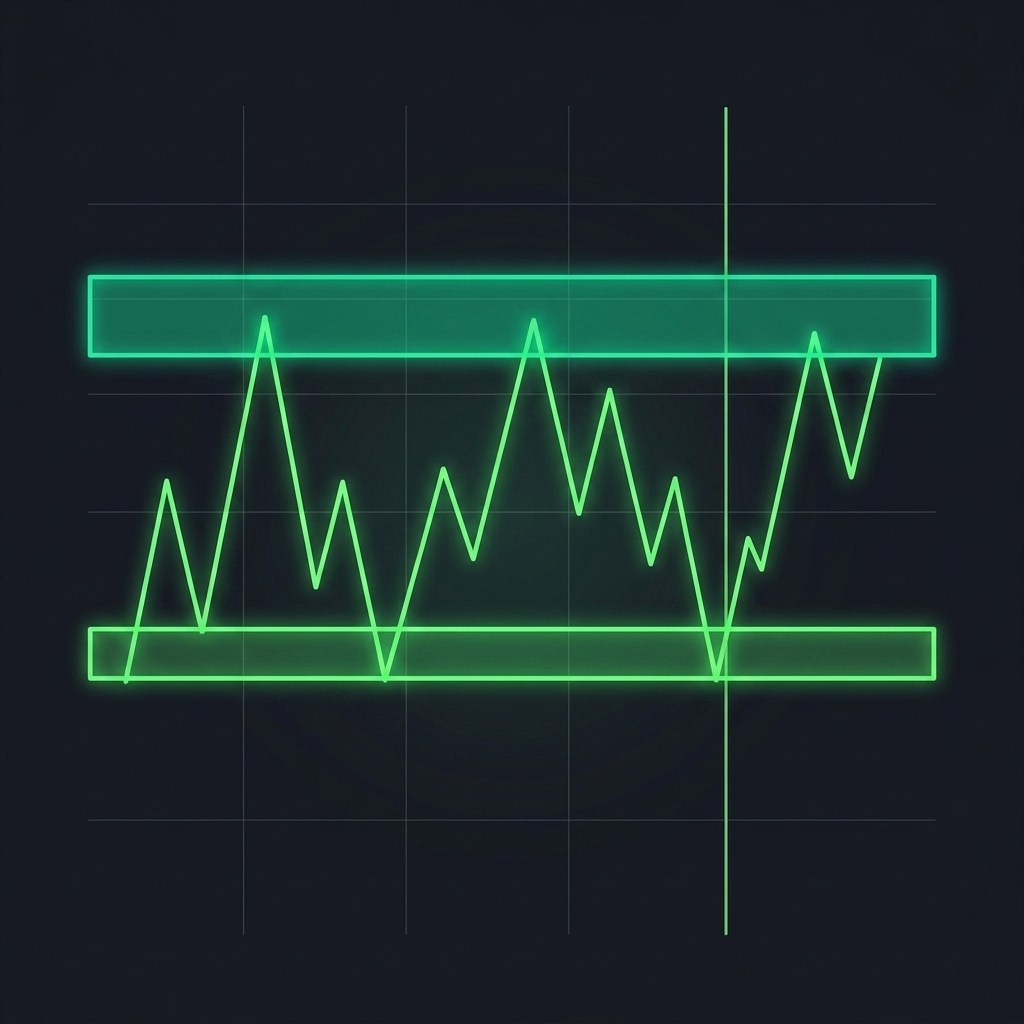
Support and Resistance (S&R) form the absolute foundation of technical analysis. They represent the physical battlegrounds between buyers and sellers.
Support acts as a “floor.” It is a price level where demand (buyers) is strong enough to prevent the price from falling further. Resistance acts as a “ceiling.” It is a price level where supply (sellers) is strong enough to prevent the price from rising higher.
While traditional trading teaches that price will magically bounce off these lines, modern trading understands that S&R levels are actually zones of intense liquidity. Because millions of traders place their entries and stop losses around these obvious levels, they become prime targets for institutional stop hunts and liquidity sweeps before major macro trends resume.
Visual Explanation
Real Trading Example
The S&P 500 has approached the 5,000 psychological price level three times over the past month. Every time it hits 5,000, massive selling volume enters the market, pushing the price back down. The 5,000 level is a major Resistance zone.
Retail traders notice this and place short (sell) limit orders exactly at 5,000, with their stop losses resting at 5,020.
On the fourth attempt, the market pushes up to 5,000. Instead of bouncing, it explodes through the ceiling, hitting 5,030. All the short sellers are stopped out. The Resistance level has been broken. Now, breakout buyers enter the market, expecting the price to go to 5,100. However, the institutions only broke the resistance to grab the stop-loss liquidity. They immediately dump their positions, and the price crashes back down to 4,950, trapping everyone.
Common Mistakes
Common Mistake
Drawing Thin Lines: Amateurs draw Support and Resistance as exact, razor-thin lines (e.g., exactly 1.05000). The market is dynamic. S&R should always be drawn as rectangular zones or areas (e.g., 1.0490 to 1.0510) to account for volatility, wicks, and institutional manipulation.
Professional Tips
Pro Tip
Support Becomes Resistance: One of the most reliable structural patterns in trading is the S/R flip. When a major Support level is finally broken, the price will frequently retrace back up to test that exact same level from underneath. The old Support floor has now become the new Resistance ceiling. This provides a highly probable entry for trend continuation.
FAQ
Why do Support and Resistance levels eventually break?
They break because the resting orders get depleted. If a Support level has 10,000 buy limit orders, the first touch might consume 4,000 orders to bounce the price. The second touch consumes 4,000 more. By the third touch, there are only 2,000 buy orders left. The selling pressure easily overwhelms the remaining buyers, and the floor breaks.
Are higher timeframe levels more important?
Yes, exponentially so. A Support level on a Daily chart represents weeks or months of institutional capital allocation. It is incredibly strong. A Support level on a 1-minute chart represents a few algorithmic algorithms fighting over lunch money. Always prioritize Daily and 4-Hour S&R zones.
How do round numbers act as Support and Resistance?
Psychological round numbers (like 1.1000 in Forex or $50,000 in Bitcoin) act as natural S&R levels. Human brains naturally gravitate toward whole numbers, so massive amounts of limit orders and take profits are mechanically clustered at these exact numerical milestones.
Related Concepts
Still have questions? Ask TradeGuardian AI.
Get instant, cited answers from our proven library of frameworks and strategies.